Animals’ Feelings and Instinctive Wisdom
Black BeautyAnimals’ Feelings and Instinctive Wisdom is made concrete through Black Beauty’s first-person account of what horses sense, fear, remember, and understand. His warning at a broken bridge demonstrates that animal knowledge can outpace human judgment; episodes of fear, illness, friendship, and care show why such knowledge deserves attention. The novel’s larger claim is not that animals reason exactly as people do, but that their distinct forms of perception and feeling are real, consequential, and too often ignored.
An Animal’s Testimony
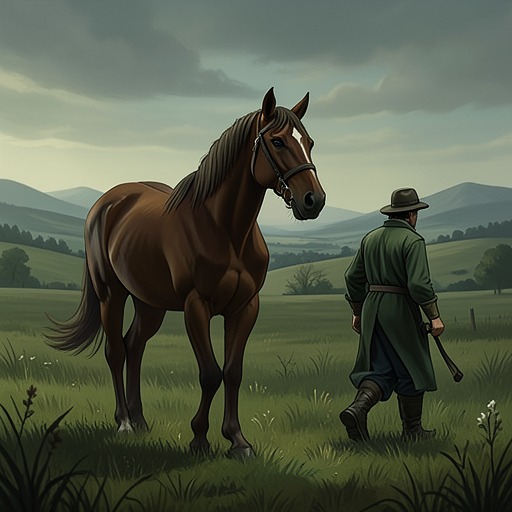
The story establishes its way of knowing through a horse’s own life history. Black Beauty remembers his early home as a meadow with a pond, trees, a warm shed, and the close company of his mother. His account gives ordinary conditions—rest, food, weather, and companionship—the importance they have from an animal’s position. This perspective turns what human observers might treat as background into lived experience, and makes the horse more than a means of transport within someone else’s story.
That perspective also distinguishes bodily knowledge from abstract instruction. Black Beauty describes being trained to accept a saddle, bridle, bit, and harness, to obey a driver, and to suppress ordinary responses such as starting at unfamiliar sights or resting when tired. The process teaches useful skills, but its demands expose a conflict: people expect a horse to comply even when tired or hungry, and often mistake obedience for an absence of feeling or will. Because the account presents what equipment and training feel like to the animal, human customs become open to scrutiny rather than appearing naturally necessary.
The Warning at the Bridge
The clearest example of instinctive knowledge comes on a dark return journey with Squire Gordon and John Manly. After a fallen tree forces them to take a long detour, they reach a wooden bridge when it is nearly dark and floodwater covers its middle. Black Beauty senses danger as soon as his feet touch the bridge and stops. Squire Gordon urges him forward and uses the whip, but the horse still will not go on. His refusal is not explained to the people around him as a reasoned argument: it is a bodily warning whose meaning they must learn to read.
John Manly gets down, comes to Black Beauty’s head, and tries to lead him forward, yet the horse remains certain that the bridge is unsafe. A man at the toll gate then hurries out with a torch and reports that the bridge is broken in the middle, with part of it carried away. Had the party continued, horse, chaise, driver, and passenger might have fallen into the fast-flowing river in darkness, with little prospect of help. Black Beauty’s resistance has prevented a disaster before the humans can see the danger for themselves.
Afterward, Squire Gordon reflects that people have reason to discover things, while animals possess knowledge that does not depend on reason and can be more prompt and perfect in its own way. John Manly recalls stories of dogs and horses performing remarkable acts and argues that people too often undervalue animals instead of making friends of them. The incident therefore changes the meaning of the horse’s refusal: what looked like disobedience becomes an act that saves human lives. Its force lies in the contrast between the whip, which demands compliance, and attention, which allows the animal’s warning to be understood.
Fear, Perception, and Training
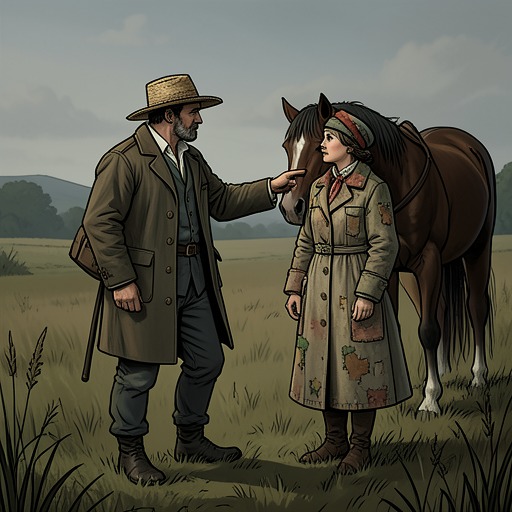
A later conversation about a horse who shies extends the issue from extraordinary danger to everyday treatment. The horse explains that blinkers restrict what he can see; when something unfamiliar appears, he must turn to look if he is to understand it. His former master answered his fear with whipping. That punishment made him start forward and more frightened, rather than allowing him to inspect the strange object and discover that it posed no danger. An old gentleman identifies the mistake: striking a frightened horse intensifies the fear and can make the habit worse.
The account treats shying not as wilful misbehaviour but as a response shaped by limited vision, unfamiliarity, and human reaction. It also preserves the horse’s own explanation of what might have helped: being allowed to look quietly and grow accustomed to new things. Black Beauty recognizes the truth of this reasoning and wishes that every young horse could have good masters like Farmer Grey and Squire Gordon. The contrast makes gentle, knowledgeable handling more than a kindness; it is a practical response to how a horse perceives and learns.
Feeling, Memory, and Companionship
The novel’s animal knowledge includes emotional and social experience, not only warnings about physical danger. When Black Beauty is gravely ill, fever makes small noises seem loud, and he follows the footsteps of people moving between the house and stable. He knows what is happening around him even when he cannot explain his condition in human speech. Earlier, after a demanding ride to get help for his mistress, he understands that the urgency is for her sake. The narrative presents attachment and awareness through the horse’s account of what he recognizes and endures.
Memory and recognition also persist through changing circumstances. Much later, Black Beauty meets Ginger beside a park: she has become an exhausted, ill-kept horse, but recognizes him and addresses him. The reunion makes their previous friendship legible across the distance between their former lives and their altered condition. At the end of his story, Black Beauty is safe in a home where his work is pleasant, Willie treats him as a special friend, and his new owners promise he will not be sold. Before waking, he often imagines himself again in the orchard at Birtwick Park with old friends under the apple trees. His remembered home and present security give emotional weight to the life he has narrated.
Ethical Significance
By letting a horse describe both the warning humans miss and the feelings their routines can disregard, the novel makes listening an ethical responsibility. Black Beauty’s bridge warning saves people only because his resistance holds long enough for John Manly and the toll keeper to discover the danger; the episode makes clear how much is at stake when an animal’s signals are dismissed. The shying horse’s story shows the same failure on a smaller, recurring scale: punishment can deepen fear when a patient opportunity to learn would address its cause.
The animal narrator does not claim that horses share human reasoning in every respect. Instead, the account asks readers to recognize forms of knowledge grounded in bodily perception, experience, and attachment—and to understand that an animal’s inability to explain itself in human language does not mean it has nothing to communicate. The book’s appeal for humane treatment rests on this combination of evidence and feeling: animals can know, fear, suffer, remember, and form bonds, and human beings have a duty to take those realities seriously.